

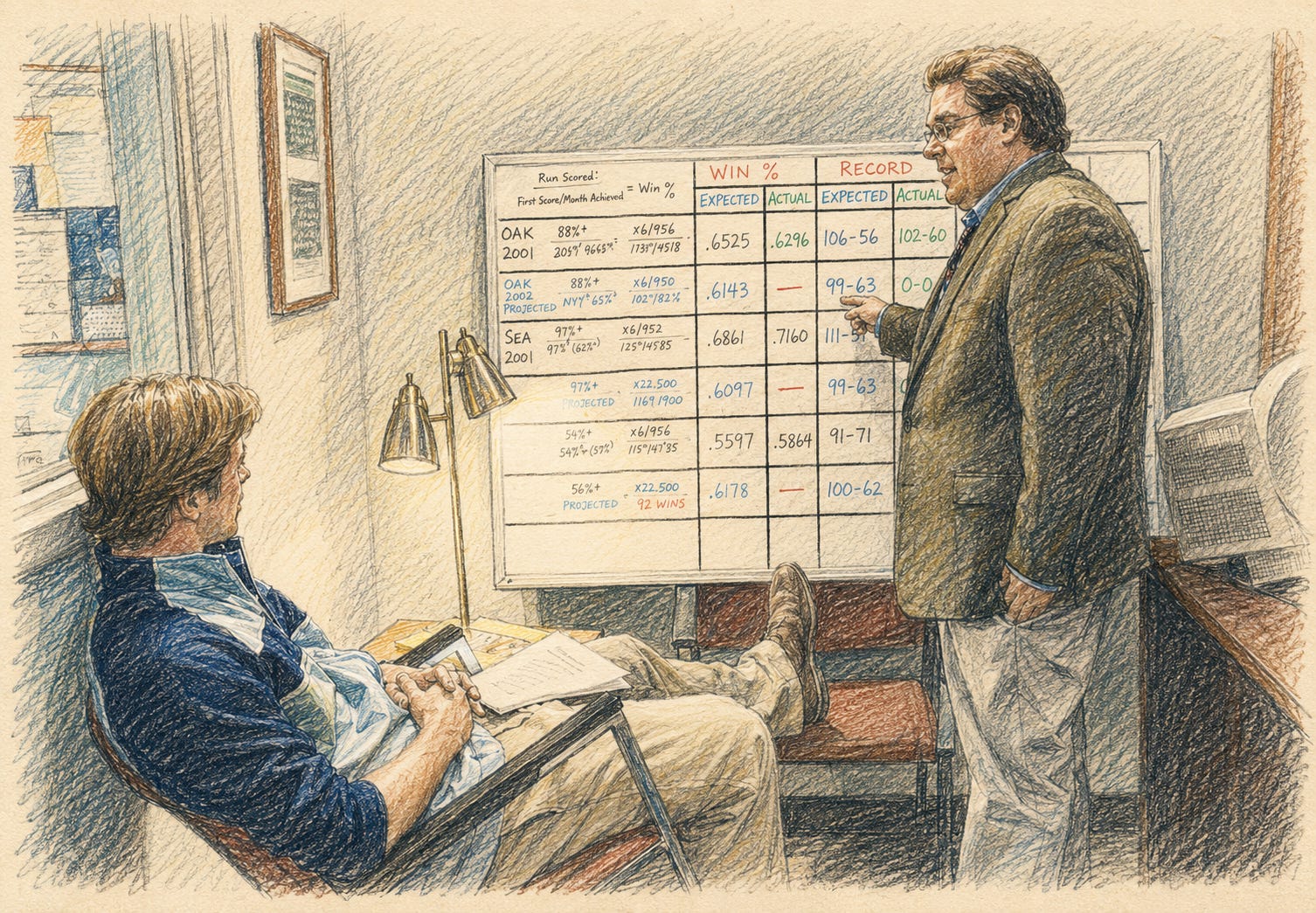
There is a comforting dream behind most goal-setting exercises. We sit in a room, open a document, and write down what we want to achieve. Then we break it into priorities, initiatives, milestones, owners, dependencies, risks, mitigation plans, and, if the organization is mature enough, at least three tables that say roughly the same thing in different formats.
For a brief moment, it feels like control. Do A, get B. Do B, get C. If the result does not happen, the explanation is ready: the goal was not clear enough, ownership was not strong enough, the roadmap was not detailed enough, or the alignment meeting did not produce enough alignment. So naturally, we add another layer of detail, because apparently the only thing standing between us and a predictable universe is a better spreadsheet.
I have been thinking about this through the work of Ilya Prigogine, the Nobel Prize-winning chemist and physicist who studied complex systems far from equilibrium. His work on dissipative structures showed something deeply uncomfortable for anyone who enjoys clean planning: in complex systems, order does not simply defeat chaos. Order often emerges from chaos. These systems are not merely complicated machines with missing documentation. They are unstable, adaptive, and open to several possible futures.
At certain points, a small fluctuation can change the system’s overall direction. The past does not mechanically produce the future. The system answers back. This is not a perfect metaphor for business, of course. Organizations are not chemical reactions. Product teams are not molecules, although on some days the difference is less obvious than we would like. But as a way of thinking, it is useful.
Many organizations still set goals as if they operate in a stable, obedient environment. As if the market will politely stay still while the annual plan is executed. As if the user behavior we observed last year will remain largely valid this year. As if the competitive landscape will wait for Q4, when we planned to review the strategy.
Reality is rarely that well-mannered. A competitor appears from a direction no one had on the slide. A technology that was supposed to be “interesting in three years” becomes normal in eight months. A stakeholder changes. A team loses key people. A regulatory risk appears. A user behavior we thought was marginal suddenly becomes mainstream. Or, more quietly, an unexpected conversation opens a much better path than the one we spent months planning.
This is the part where traditional goal-setting often goes wrong. Not because goals are useless. They are not. The problem is not a lack of goals. The problem is pretending that goals give us control over things we can only influence.
A good goal creates direction. It helps people choose. It gives teams a shared language for trade-offs. It says: this is what matters, this is what we are trying to change, and this is the effect we believe is worth pursuing. A bad goal pretends to be a contract with the future. And the future, as usual, did not sign it.
In product work, this distinction matters a lot. A roadmap is often treated as a delivery promise, but in a complex environment it should be closer to a structured hypothesis. We believe these problems are important. We believe these solutions may work. We believe this sequence makes sense based on what we know now. The key phrase is “based on what we know now,” not “based on what we hope will remain true forever.”
The greater the uncertainty, the less useful it is to worship the original plan. Yet this is exactly what many organizations do. When reality becomes less predictable, they respond by demanding more precision from the plan: more milestones, more reporting, more governance, and more status updates explaining why the world has failed to comply with the roadmap. This is not management. This is administrative weather control.
The better question is not “How do we remove uncertainty?” We cannot. The better question is: “Which parts of this system can we influence, and where do we need to stay alert enough to adapt?” That requires a different kind of discipline. Less theatrical certainty and more honest observation. Less obsession with predicting the exact output and more attention to signals. Less punishment for changing course when the evidence changes, and more ability to distinguish between abandoning a goal and updating a hypothesis. This is where many teams struggle. Not because they lack ambition, but because they confuse flexibility with weakness. They think adaptation means giving up. But in reality, adaptation is often the only serious form of execution. Rigid plans look strong in presentations. Adaptive systems survive outside them.
The irony is that the best outcomes in our lives and work often come from things we did not fully plan. A meeting that was not supposed to matter. A side conversation after the official discussion ended. A small experiment no one expected much from. A person who entered the picture late and changed the whole direction. A constraint that forced a better idea. But these outcomes are not pure luck.
Chance opens the door. Preparedness notices it. Competence uses it. This is why the next evolution of goal-setting should not be about abandoning goals and becoming passive observers of chaos. That would be just another fashionable excuse, and we already have enough of them.
The evolution should be about intellectual honesty. We need goals, but we should stop pretending that all goals are control mechanisms. Some are direction markers. Some are bets. Some are learning tools. Some are useful only until the system gives us a better answer.
The mature approach is not to say: “Here is the plan, and reality must follow.” The mature approach is to say: “Here is our direction, our current hypothesis, what we can influence, what we need to watch, and how we will know that the system is telling us something important.” It is less comforting than a beautiful annual plan, but it has one advantage. It is closer to how reality actually works.