

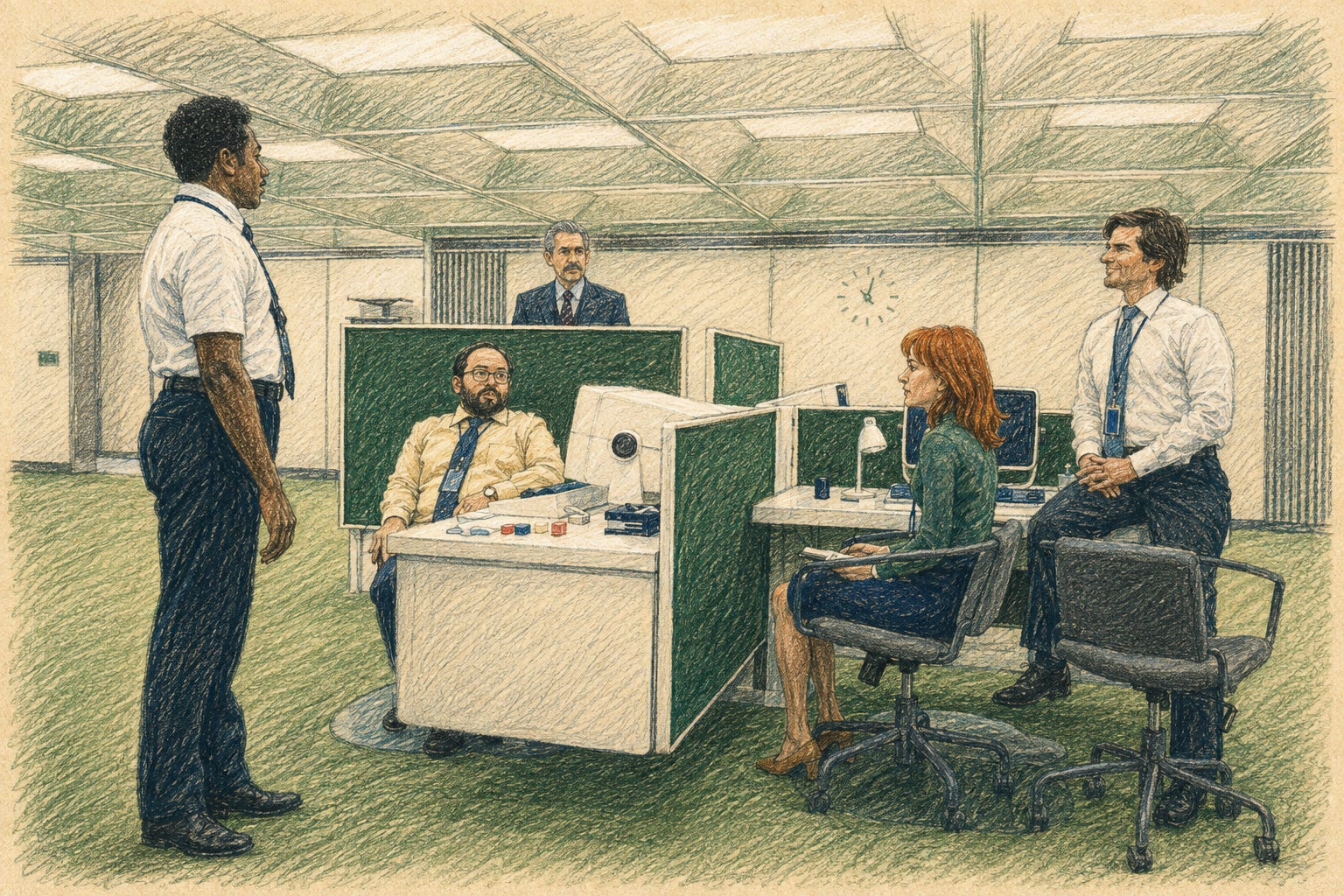
They attend the same meetings, make decisions, resolve conflicts, protect their teams and explain yet another change of priorities. They translate confusing messages from above into something people can actually work with. They are busy, responsible, often respected and almost permanently tired. But ask them what they are trying to build, and the answer sometimes becomes surprisingly unclear. Somewhere along the way, without a formal announcement or a change in the job description, their job has changed. They are no longer managing the system. They are managing their ability to survive it.
There is a concept I keep seeing: endurance instead of management. It describes the point where a manager stops choosing between possible futures and starts choosing between different versions of discomfort. Fire someone or keep carrying them. Challenge the boss or stay quiet. Fight for the team or conserve political capital. Leave or give it another six months. Monday mornings become a negotiation with yourself about whether to keep buying your own job. This can go on for years.
The problem is not that management should be pleasant. That would be a rather optimistic misunderstanding of management. Leadership comes with conflict, uncertainty, unpopular decisions, difficult people, failed bets and occasional meetings that make you question several of your life choices. Difficulty is part of the job. The more useful question is: What are you buying with it? You can go through a brutal reorganization because you know what organization you are trying to build. You can fight a painful political battle because an important product depends on it. You can spend six difficult months rebuilding a team because you can see what should exist on the other side. There is an exchange. The frustration has a purpose, a direction and, ideally, an end.
Endurance has its own economics. You adapt, then adapt again, and eventually, staying becomes the main achievement. This is where good managers become highly skilled, but not always at management. They learn to read the boss’s mood before the meeting starts. They know which proposal can be presented on Tuesday but not on Friday afternoon. They learn how to phrase commitments so they cannot be used against them later. They become translators of organizational chaos. They know which battles to avoid, which decisions to delay, and how much bad news their team can absorb. These are real skills, sometimes sophisticated. The catch is that they are optimized for survival in one specific system.
A manager can spend five years getting very good at navigating dysfunction, while only slightly better at building something functional. Companies often reward this. We call these people resilient. We say they can handle pressure. We praise them for keeping things together. Eventually, they become indispensable. That should probably concern us more than it impresses us, because a strong manager can hide a weak organization for a long time.
A broken process creates chaos, so the manager compensates. Leadership provides no clarity, so the manager creates clarity for the team. Priorities change every two weeks, so the manager manually reallocates people. Bad decisions come from above, so the manager absorbs the consequences before they reach everyone else. Delivery continues, employees keep working, and the numbers may even look acceptable. The organization looks at all this and reaches a logical but wrong conclusion: apparently, the system works. It does not. Someone is just paying its operating costs with their nervous system.
This is a different kind of organizational debt. Instead of fixing structural problems, the company finances them with the energy of capable people. Unlike technical debt, it rarely appears on a dashboard. There is no Jira ticket saying, “Our organizational model requires three senior managers to spend 40% of their emotional capacity compensating for bad decisions.” The cost is hidden inside people. The better those people are at their jobs, the longer the debt stays invisible.
There is an important distinction here, because I would not dismiss all endurance as wasted effort. Protecting your team from chaos can absolutely be a leadership act. Keeping a critical team together during a crisis can be a major achievement. Preventing a disaster is still a result, even if LinkedIn prefers achievements with percentages and upward-pointing graphs. The real difference is whether you process the pressure or merely store it. A good manager can receive confusion from above and return clarity below. Pressure becomes a priority. Conflict becomes a decision. Uncertainty becomes a plan. Something has been transformed, and the organization is slightly better as a result.
But sometimes nothing changes. The manager just absorbs more dysfunction so everyone else can keep working. They become a buffer between a broken system and the people trying to do actual work. From the outside, this can look like excellent leadership, especially because the team may benefit. But the manager is no longer processing organizational pressure. They are storing it. A professional, calm, well-paid storage facility for organizational waste.
This also explains something I have seen in senior-level interviews. A candidate arrives with an impressive title and five or seven years inside a famously difficult company. You ask what they achieved, and the answer becomes strangely foggy. They managed through a very complex environment. They maintained alignment between multiple stakeholders. They protected the team during a turbulent period. All of this may be completely true, and it may have required extraordinary effort. But it can be surprisingly difficult to understand what actually changed because they were there.
Sometimes this is unfair to the candidate because defensive leadership produces results that are hard to see. Nothing collapsed. Key people did not leave. Delivery did not stop. The political explosion never reached the team. These are negative outcomes, things that did not happen, and they are much harder to put on a CV. But there is another, less comfortable possibility. After years of endurance, the manager may have built an impressive history of surviving situations without an equally impressive history of changing them. Their experience is real, their effort is real, their exhaustion is real, but their managerial repertoire may have become specialized around survival.
So maybe there is a better question than ‘Am I burned out?’ or ‘Is my job too stressful?’ Ask yourself: Over the last two years, what changed more, the system because of me, or me because of the system? Did you change the organization, processes, products, team, responsibilities, decision-making, or relationships between functions? Or did you mostly learn to tolerate more ambiguity, politics, contradictory decisions, unnecessary meetings, and Sunday-evening dread? Some adaptation is part of every leadership job. But if adaptation becomes the main thing you are getting better at, something important has shifted.
Management should leave evidence in the system. Endurance mostly leaves evidence in the manager.
And this is where the problem stops being personal and becomes organizational. A company creates dysfunction. Strong managers compensate for it. Their compensation makes the dysfunction less visible. The organization rewards them for resilience and promotes some of them. Eventually, the people who became successful by learning how to survive the system become responsible for designing it. What was once an emergency coping mechanism slowly turns into a management culture. New managers arrive, discover the same problems and are told — explicitly or implicitly — that this is simply what leadership looks like here.
Full circle.
Maybe the real measure of leadership is not how much pressure you can handle. Perhaps it is how much unnecessary pressure you can remove from the system, how much organizational debt you can stop paying with people, and whether the manager who comes after you will need to become as “resilient” as you did.
Because if surviving the organization has become one of the most important management skills, the problem is probably not the managers.