

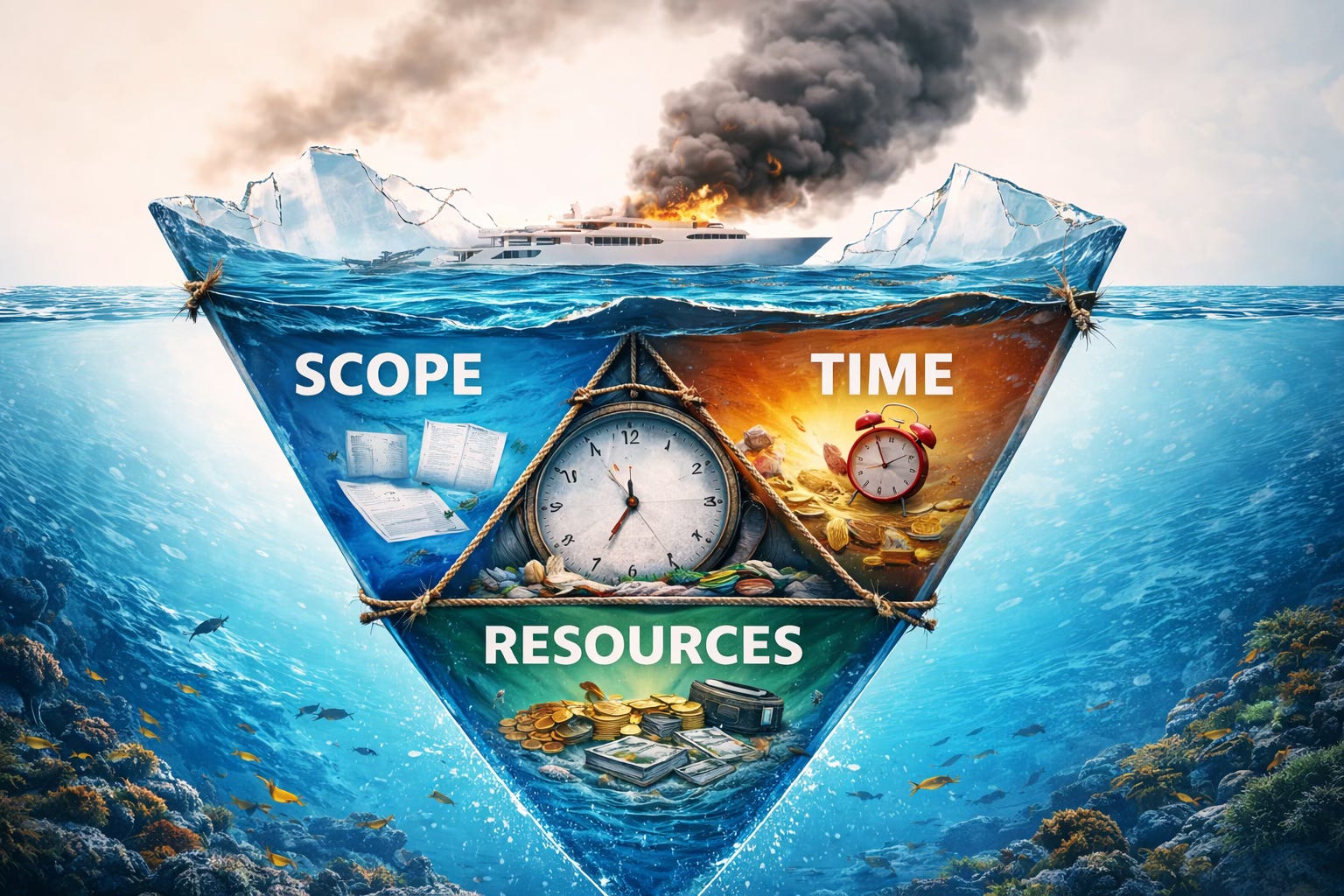
Most project pain doesn’t show up with chaos or obvious mistakes. Instead, it comes quietly, as a familiar heaviness: another deadline that feels tight for no clear reason, another scope discussion that changes nothing, another delivery where everyone worked hard but still leaves tired and vaguely dissatisfied.
This is usually when people start blaming execution, communication, or alignment. Sometimes they blame the market or “the reality we’re in.” Almost never the real cause.
If this sounds familiar, it matters for a simple reason: this kind of pain builds up. It slowly eats away at credibility, energy, and trust until you only notice it when it feels normal.
Most of us have seen this pattern. A project starts with ambition and optimism. The scope is important, maybe even strategic. The deadline matters, often for outside reasons. The team is strong but “lean for now.” Everyone nods, understands the constraints, and agrees to “stay flexible.”
Yet somehow, all three sides of the triangle — scope, time, and resources — end up treated as non-negotiable.
This is where the trouble starts.
We often talk about the classic project triangle as something to balance. It sounds reasonable and professional. But balance is a comforting word that hides a hard truth: trade-offs aren’t balanced, they’re chosen or avoided. Avoiding them is still a choice; it just delays the cost.
I call this the Triangle of Sadness. Not because constraints are bad, but because pretending they don’t hurt is worse. The sadness isn’t in the triangle itself. It’s in the group decision to act as if commitment has no cost.
That’s why “marriage” is a better metaphor than “balance.” Marriage means exclusivity. If you marry scope, speed will suffer. If you marry time, ambition must narrow. If you marry fixed resources, you accept limits on both scope and pace. Any of these marriages can work, but you can’t secretly marry all three and hope no one notices.
What actually happens when we try is predictable. Scope quietly becomes tougher. Deadlines turn emotional instead of rational. Teams work harder. Quality slips. Temporary fixes become permanent. Heroics are praised. Fatigue becomes normal. Later, the project is called “challenging, but successful.”
This is usually when teams get blamed for not pushing back enough. That’s convenient, but mostly wrong. Teams don’t break the triangle. Organizations do, when they push unresolved trade-offs down and call it empowerment.
The real failure here isn’t delivery. It’s owning the decisions.
Someone, somewhere, wants certainty without paying for it. Leadership wants confidence. Product is asked to handle ambiguity. Delivery pays the price. Everyone stays polite. No one says the trade-off out loud. And when the project hurts, the triangle quietly makes the choice for you.
This keeps happening because the incentives are subtle. Optimism gets rewarded. Saying “we’ll figure it out” feels helpful. Naming trade-offs feels political. Ambiguity buys time until it gets expensive. By the time pain is obvious, it’s already seen as an execution problem, not a decision problem.
The irony is that none of this is new. The triangle isn’t a secret. Everyone knows about it. What’s rare is treating it as a real moment of truth, not just a diagram in a slide deck.
A project isn’t healthy just because it delivers everything on time with limited resources. That’s a slogan, not a strategy. A project is healthy when everyone can clearly say which side of the triangle was chosen, why, and by whom, and accept the consequences without surprise.
That kind of clarity doesn’t remove tension. It removes confusion. And confusion costs much more.
So here’s the uncomfortable question I keep asking: when your last project hurt, could everyone clearly name the trade-off that was made? Or did the Triangle of Sadness quietly decide for you while everyone stayed busy?
Because the triangle never goes away. It just waits until someone is honest enough to face it.