

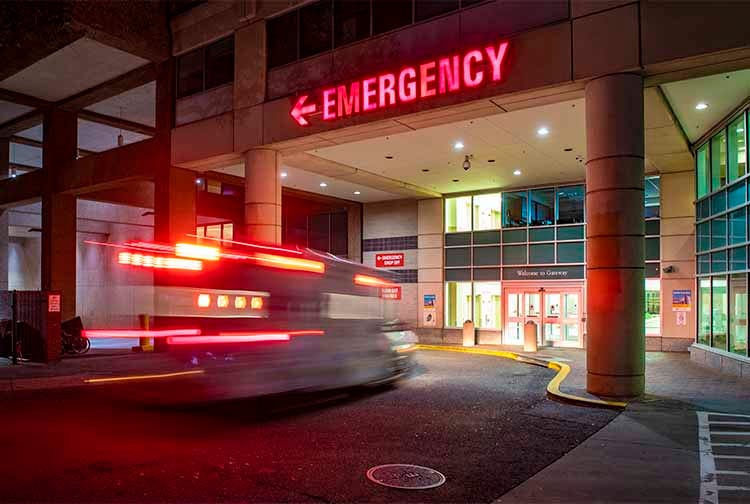
Most software companies reach a point where everything starts to feel reactive. Tickets accumulate, users get louder, teams get busier. Dashboards show activity. Everyone is busy, but the system is not improving.
And yet, somehow, nothing feels under control.
This is when it becomes clear: what you have is not a support function. It is an Emergency Room. Not as a metaphor, but as an operating model.
Once you recognize the pattern, it is difficult to ignore.
Intake and triage: where everything already starts going wrong
In an actual Emergency Room, nobody treats patients in the order they walked in. A broken finger does not go ahead of a heart attack. That sounds obvious. Until you look at many Customer Care queues.
Tickets come in through forms, email, chat, Slack, and sometimes a phone call from someone senior. Without real triage, everything merges into one stream. The loudest or most recent issue gets attention, or the one with the most senior escalation.
A mature support team behaves more like medical triage than inbox management. It classifies issues by severity, impact, and urgency within minutes. It routes them intentionally. It accepts that some cases will wait. And that this is not negligence, but prioritization.
Most teams do not have a capacity problem. They have a triage problem.
Decisions under uncertainty: guessing, but professionally
In Emergency Rooms, doctors rarely have perfect information. They work with symptoms, fragments, probabilities. They make a call, act, and adjust.
Customer Care operates in the same fog. “The CMS is slow.” Which part? For whom? Since when? No one knows yet. But the clock is already ticking.
Good support agents develop clinical instincts. Pattern recognition. A sense of “this smells like a caching issue” or “this is probably a permissions edge case.” They don’t wait for perfect clarity. They move the case forward while gathering evidence.
Bad systems, on the other hand, demand complete information upfront. They stall. They bounce tickets back to users: “Please provide more details.” Meanwhile, the incident grows quietly in the background.
Hesitation is costly in both settings. In software, we often act as if it is not.
Resource constraints: you don’t have enough, you never will
Emergency Rooms are always constrained — beds, staff, equipment. When a surge hits, something has to give.
Customer Care teams face the same constraints. Agent capacity is limited. Engineering attention is even more limited. When the CMS fails during a peak publishing window, every ticket becomes urgent.
This is when the system shows its actual design. Are there clear incident modes? Can you reassign resources? Do you ignore non-critical requests, or try to handle everything and end up failing across the board?
Most organizations say they have priorities. Few enforce them when it matters.
Escalation pathways: where time is usually lost
In an Emergency Room, escalation is not a failure. It’s the system working as intended. A generalist stabilizes, a specialist intervenes, the case moves forward.
In Customer Care, escalation often becomes a bureaucratic process. Tickets move with missing context. Engineers repeat the same questions. Product teams join too late or too early. Many people are involved, but ownership is unclear.
The difference between a functional and dysfunctional system is not escalation itself, but how it operates. Good escalation brings structure, ownership, and clear expectations. Bad escalation brings frustration.
And frustration, unlike tickets, does not close.
Time sensitivity: SLAs are just a polite version of urgency
In medicine, urgency is obvious. In software, we hide it behind SLAs. “Response within 4 hours.” “Resolution within 24 hours.”
But when your CMS goes down during a major news event, nobody is thinking in SLA language. That is not a “P1 ticket.” That is an emergency.
The issue is not the existence of SLAs. The issue is treating them as a replacement for judgment. Teams optimize for compliance, not for impact. They respond within the window, but do not always solve the problem.
In an Emergency Room, stabilizing the patient matters more than updating the chart. The same principle applies more often than we admit.
Emotional load: you’re not just solving problems
Emergency Room staff deal with fear, panic, and occasionally anger. The technical problem is only part of the job. The emotional state of the patient is the rest.
Customer Care agents live in a softer version of the same reality. Users are frustrated. Editors are blocked. Stakeholders are anxious. And the tone of communication can escalate faster than the issue itself.
Here is the nuance many teams miss: communication is not a wrapper around the solution. It is part of the solution.
A well-timed message can prevent escalation. A poorly handled one can turn a minor issue into a major conflict. The system can be fixed, but the user can still be lost.
Feedback loops: treating symptoms vs fixing the disease
Every Emergency Room generates data. Patterns emerge. Certain injuries spike at certain times. Certain conditions repeat. This informs prevention, staffing, public health.
Customer Care should do the same. Recurring tickets are not “business as usual.” They are signals. Poor UX, fragile features, unclear workflows. They all surface through support long before they appear in product metrics.
Many organizations treat support as an endpoint. Tickets arrive and are resolved, but there is no structured feedback into product. No prioritization based on support data. The same issues quietly return each week.
At that stage, the work is not solving problems. It is managing their recurrence.
From emergency response to preventive care
Here is where the analogy becomes uncomfortable.
A hospital that invests only in its Emergency Room is not a good hospital. It is an overwhelmed one. Real healthcare systems invest heavily in prevention: primary care, early diagnosis, reducing the need for emergencies in the first place.
The same is true for software.
A Customer Care team that is always busy is not a sign of success. It is often a sign that the product is generating problems faster than they can be addressed. Onboarding is unclear, workflows are fragile, and edge cases are now common cases.
Preventive care in a CMS environment looks less dramatic, but more valuable. It is better defaults. Clearer interfaces. Fewer clicks to publish. Smarter error messages. More resilient infrastructure. Thoughtful constraints that prevent users from getting into broken states.
It also means taking support data seriously. Not as anecdotes, but as input into roadmap decisions. If 30% of your tickets come from one feature, that is not a support issue. That is a product decision waiting to happen.
This work is less visible. There is no late-night incident, no dramatic recovery. There are simply fewer emergencies.
Which, ironically, is the real goal.
Most software companies eventually build an Emergency Room. They don’t always admit it. They call it Customer Care, Support, Helpdesk. But the dynamics are the same.
The more interesting question is what happens next.
Do you keep optimizing the Emergency Room for faster triage, better escalation, tighter SLAs? Or do you start asking why so many patients keep showing up in the first place?