

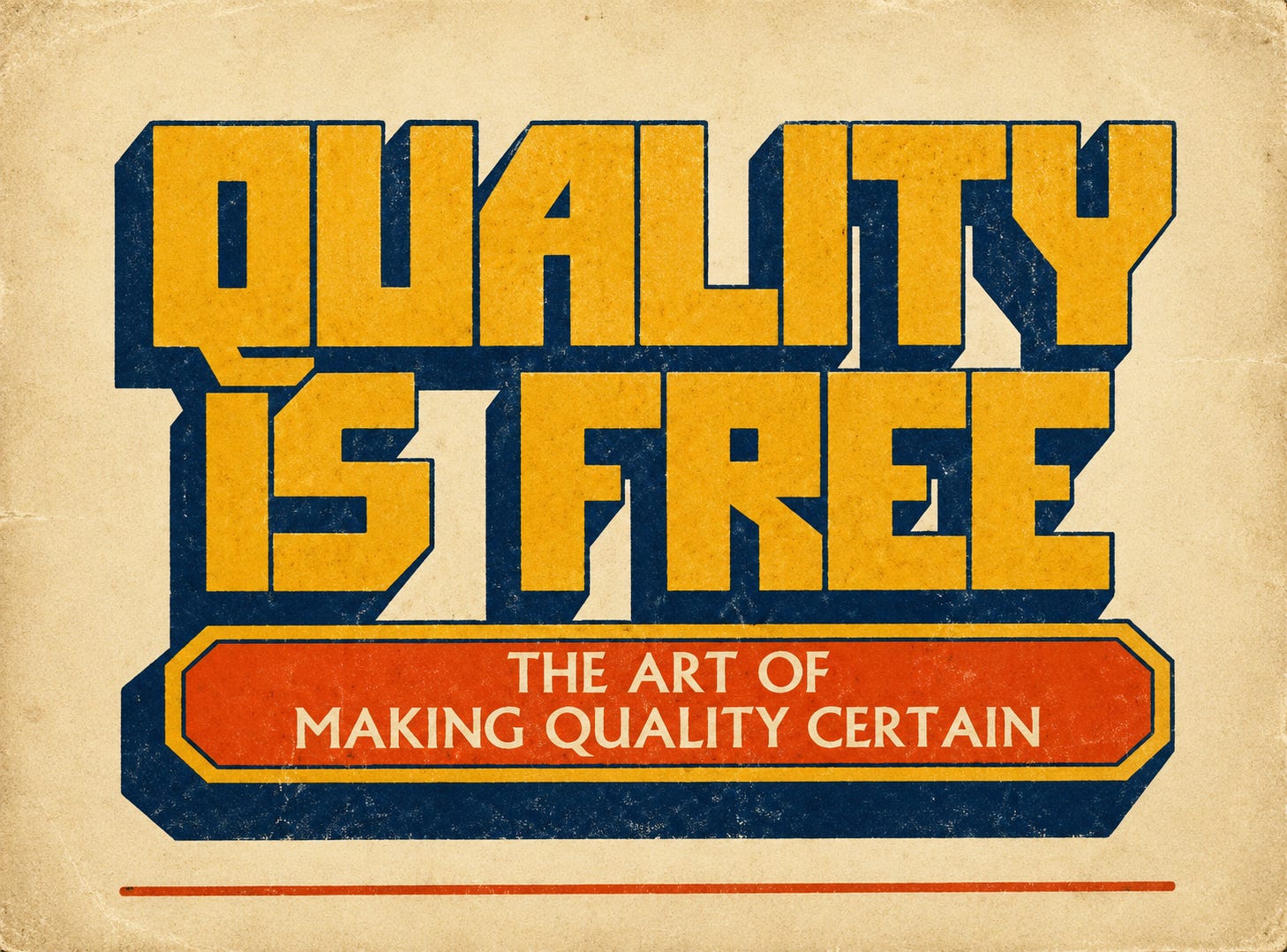
Some management books age badly. You open them 30 years later and find advice that sounds like it was written for a factory overseen by a man smoking next to a forklift.
Philip Crosby’s Quality Is Free, first published in the late 1970s, is strange because half of it feels completely outdated — and the other half feels uncomfortably modern.
The title itself sounds almost absurd today. “Quality is free.” Right. Tell that to a product team drowning in technical debt, a newsroom fixing broken embeds at midnight, or an engineering manager negotiating cloud costs after another emergency rollback.
But Crosby’s point was never that quality costs nothing. His point was that the absence of quality is catastrophically expensive.
That idea has survived surprisingly well.
For years, I have had a slightly provocative theory about work: lazy people often produce higher-quality work on the first attempt.
Not always. There is obviously the destructive kind of laziness too. But experienced, intelligent laziness is different. It hates repetition. It hates fixing the same thing twice. It hates unnecessary motion, unnecessary meetings, unnecessary debugging, unnecessary explanations, unnecessary support tickets.
So these people quietly optimize for permanence.
They write the cleaner process because they do not want to answer the same question fifteen times. They automate the workflow because manual repetition irritates them. They document things because they do not want late-night calls. They think through architecture because they do not want emergency rewrites six months later.
Meanwhile, organizations often reward the opposite behavior: visible urgency, heroic recovery, chaotic multitasking, dramatic late-night fixes, endless firefighting. Entire careers are sometimes built on solving problems that should never have existed in the first place.
Crosby would probably appreciate the irony.
Back in the 1970s, he was mostly talking about manufacturing defects, production lines, warranties, scrap, inspections, and rework. The world was industrial, hierarchical, and obsessed with process control. The enemy was the defective physical product.
Half a century later, the factories became platforms, APIs, apps, recommendation engines, analytics pipelines, AI systems, and distributed cloud infrastructure. But the defects never disappeared. They just changed shape.
Today’s “scrap” is not metal in a warehouse. It is engineering time lost to regressions. It is product managers holding alignment meetings about problems that should never have existed. It is support teams manually correcting workflows. It is editors working around broken CMS logic. It is developers fixing rushed integrations at 2 a.m. because “we’ll clean it up later” somehow became an operating model.
And just like in Crosby’s time, organizations still underestimate the cost of all this invisible chaos.
One of Crosby’s most controversial ideas was “Zero Defects.” Modern people instinctively dislike the phrase because it sounds unrealistic, authoritarian, or detached from reality. In software, especially, people love saying that “bugs are inevitable,” which is true. But Crosby was not really arguing for perfection. He was arguing against normalization.
That distinction matters.
Many organizations quietly build cultures where recurring problems become folklore rather than priorities. Everyone knows the broken workflow. Everyone knows the unreliable report. Everyone knows the feature that randomly fails under load. Entire teams adapt to dysfunction, like people in an old apartment building learning which stair steps creak.
Eventually the workaround becomes more stable than the actual system.
Crosby would probably hate modern startup culture. Not because of technology, but because of the mythology of speed. “Move fast and break things” sounds exciting until you realize someone has to maintain the broken things. Usually, with half the original team gone and the documentation written by archaeologists.
At the same time, some things have changed dramatically since the late 1970s.
Back then, quality management was deeply centralized. Committees, formal programs, structured initiatives, quality departments, slogans on walls. Today, quality is far more embedded in operational systems. CI/CD pipelines, observability, automated testing, SRE practices, feature flags, incident management, telemetry, DevOps culture — much of modern engineering is essentially automated quality management wearing a hoodie instead of a necktie.
Even Crosby’s famous idea that “quality must start at the top” has evolved. Modern organizations increasingly understand that quality is systemic. Leadership still matters enormously, but quality now emerges from incentives, architecture, tooling, communication patterns, deployment practices, staffing realities, and organizational trust.
Ironically, AI is making Crosby’s arguments even more relevant today.
AI dramatically lowers the cost of producing things quickly. But it also lowers the cost of producing bad things quickly. Hallucinated summaries, unreliable automations, synthetic content errors, broken AI workflows, low-quality code generation — the scale of potential rework is becoming enormous.
The old industrial defect is becoming a probabilistic defect.
Which brings us back to Crosby’s original argument from the late 1970s: prevention is cheaper than correction.
Still true.
Not because humans became smarter. Not because technology solved complexity. But because organizations still pay for every shortcut, eventually. The invoice simply arrives later, in a different department, under a different budget line, in a different quarter, explained by a different PowerPoint presentation.
Half a century later, that part aged perfectly.