

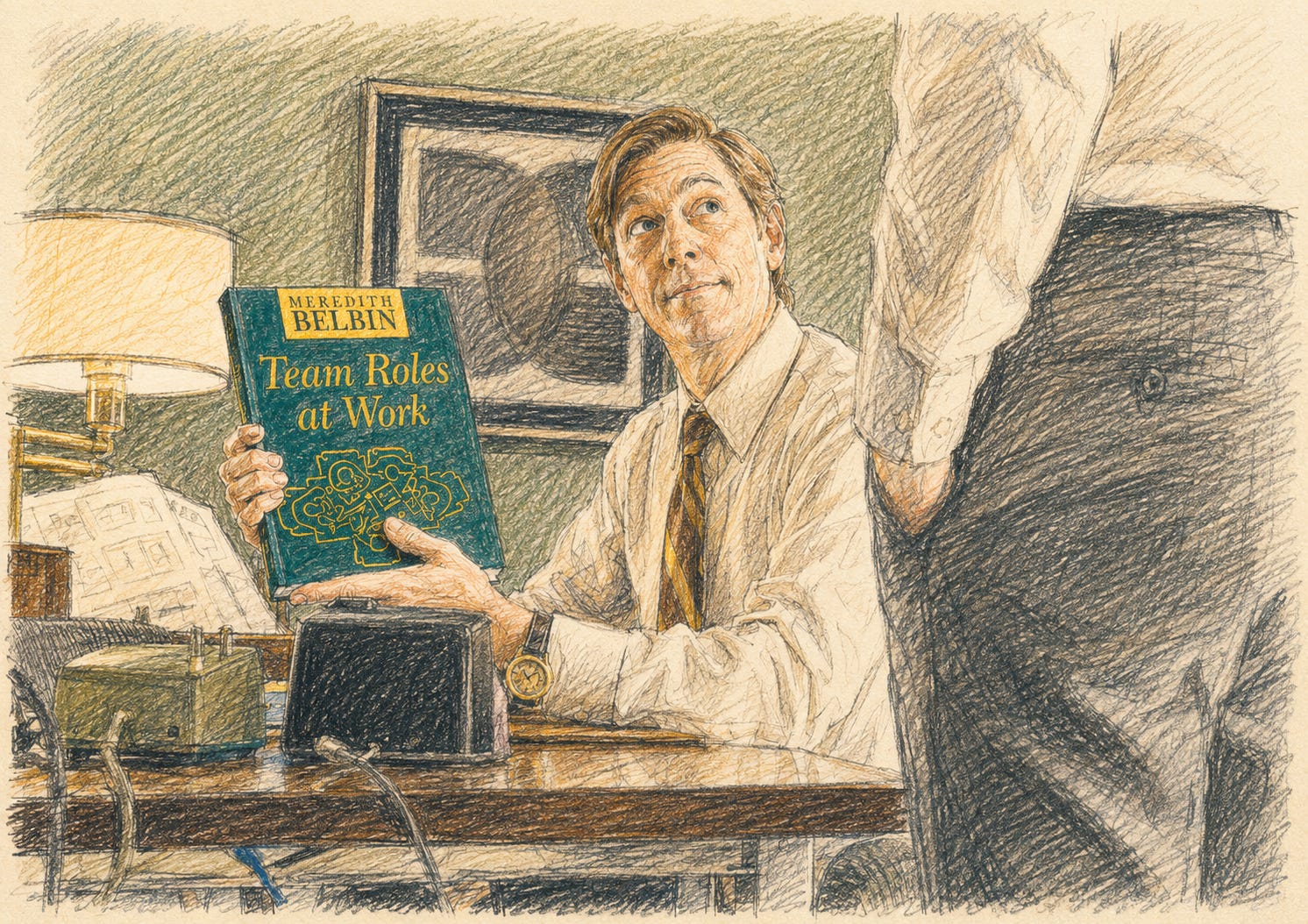
A few weeks ago, I attended a workshop on Belbin’s Team Roles. You probably know the concept, or at least the general idea behind it. Every effective team needs different types of contributions. Some people generate ideas, some turn ideas into practical plans, some challenge inertia, some analyze risks, some maintain relationships, some bring deep expertise, and some make sure the work is actually finished rather than becoming another beautifully designed slide in the corporate museum of unfinished intentions.
So far, so good.
Then we came to the part where the idea of a team without a leader appeared. This is where my inner corporate heretic politely raised his hand.
Not because I believe every team needs a boss. Quite the opposite. The best leaders are not always the loudest in the room, and they are definitely not the ones who measure leadership by how many follow-up messages they send after every meeting. A leader is not someone whose main function is to ask, “Any updates?” across five different communication channels. That is not leadership. That is calendar-based anxiety with admin permissions.
But I do believe every serious team needs leadership. There is a difference. A boss controls; a leader enables. A boss wants to be at the center; a leader creates conditions in which other people can do their work. A boss treats the team as a delivery machine; a leader understands that the team is a system of people, roles, expectations, conflicts, priorities, constraints, external pressure, unclear requirements, and the occasional stakeholder who enters the room carrying a “small request” that somehow requires three months of engineering work.
Belbin’s model is useful because it reminds us that teams need different types of contributions. A team made only of idea generators may produce an impressive number of concepts and almost no output. A team made only of implementers may deliver efficiently in the wrong direction. A team made only of evaluators may analyze the project to death. A team made only of relationship-builders may create a safe and friendly environment where nobody wants to ask why the deadline was missed. Balance matters, and the model clearly shows why.
But balance does not eliminate the need for responsibility.
This is where I struggle with the romantic idea of leaderless teams. It often sounds appealing in workshops, especially when everything is theoretical, the coffee is still hot, and no real stakeholder is waiting for an answer by the end of the day. In theory, the team self-organizes. In theory, decisions emerge naturally. In theory, people align around the best argument. In theory, everyone owns the result. Then reality arrives, usually without reading the workshop handout first.
A deadline slips. Two departments want opposite things. A senior stakeholder pushes for a shortcut. A technical risk is discovered late. A conflict within the team stops being a “healthy disagreement” and becomes a polite civil war waged through Jira comments. Suddenly, “shared ownership” starts to look suspiciously like “nobody is actually responsible.”
This is the moment when teams need more than roles. They need someone who can say: “Here is the decision. Here is why. Here is what we will do next. And I own the consequences.” That person does not need to dominate the team. They do not need to have all the answers. In fact, if they think they have all the answers, they are likely the problem. But someone must own the frame.
Someone must protect the team from noise, represent the team to the outside, resolve conflicts when good intentions fall short, and connect internal work to external reality. Someone must ensure that autonomy does not become isolation and that collaboration does not become permanent consensus-seeking. This, to me, is leadership. Not command and control. Not corporate theater. Not “let’s circle back” as a lifestyle. Leadership is the function that enables all other functions to work.
A strong leader enables the Plant to bring ideas without letting the team lose itself in abstract creativity. They help the Implementer turn plans into action without reducing every discussion to a checklist. They let the Monitor Evaluator challenge assumptions without creating a culture of permanent skepticism. They support the Teamworker without making harmony more important than truth. They value the Specialist without allowing expertise to become a private kingdom. Good leadership does not replace team roles. It makes them usable.
This is why the phrase “leaderless team” often feels misleading to me. Many teams that call themselves leaderless still have leadership. They just do not call it that. Someone coordinates. Someone facilitates. Someone exerts influence. Someone breaks deadlocks. Someone represents the group. Someone becomes the person others look to when things get difficult. The title may disappear, but the function remains.
And when the function disappears, the consequences are usually not very modern or progressive. They are just messy.
The strongest teams I have seen do not rely on a leader for every small decision. That would be slow, exhausting, and frankly insulting to capable professionals. Strong teams make many decisions themselves. They challenge each other. They draw on expertise. They do not wait for permission to breathe. But they also know where accountability lies. They know who protects the mission when priorities collide. They know who owns escalation. They know who can make the unpopular decision when all available options are imperfect. They know who carries the responsibility when the beautifully balanced team roles are not enough.
So maybe the real question is not whether teams need a leader. The better question is what kind of leader the team needs. If the answer is “someone who controls every step,” the team is probably not mature enough, or the leader is not. If the answer is “nobody, because we are all adults here,” that may work for a while, especially while things are calm. But when pressure comes, leadership stops being a job title and becomes infrastructure.
And like most infrastructure, nobody appreciates it when it works. They only notice when it is missing.