

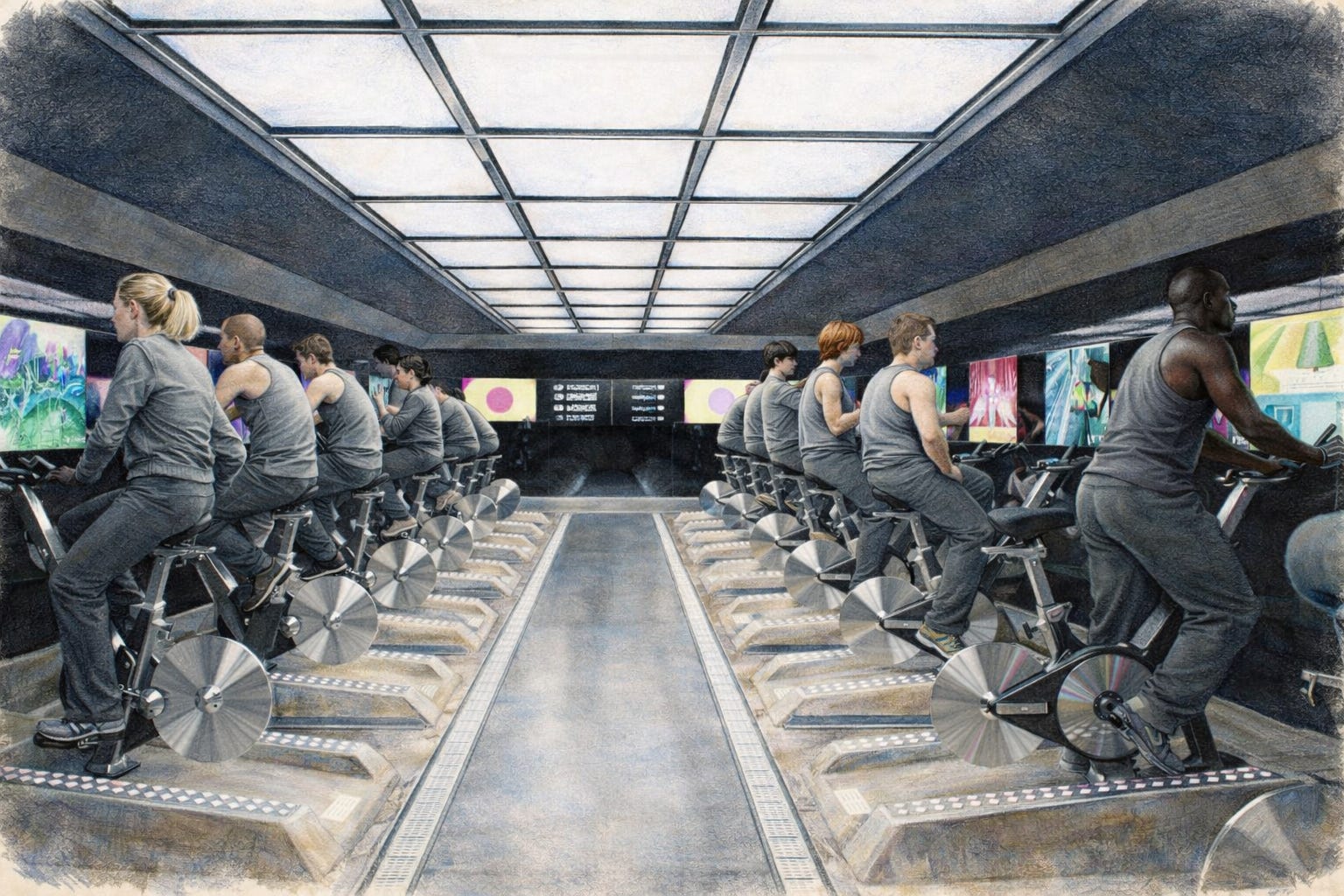
Jogging did not become mainstream because people suddenly discovered discipline. It became normal because the cost of ignoring physical health became visible, then hard to ignore. Now, not caring about your fitness is the exception, not the rule.
We could see the same shift with mental discipline. The ability to focus, to read deeply, to think without interruption might stop being assumed and start being recognized as rare. And as with physical fitness, what is rare tends to become valuable. The metric just changes from steps to minutes of undistracted attention.
The analogy is not perfect, but it is close enough to make people uneasy. We spent decades learning how to train the body. The brain, meanwhile, was left to fend for itself. Now, as our environment quietly shifts to make focus harder, we are only just noticing the side effects.
We Fixed the Body. We Outsourced the Brain.
Physical fitness did not become a movement because people woke up one day with more willpower. It happened because the downsides of ignoring the body became obvious, then embarrassing. Sedentary living and bad diets stopped being invisible. They became problems with names, metrics, and solutions.
With mental focus, we are still pretending nothing has changed. We act as if attention and depth are default settings, immune to environment. Meanwhile, we keep redesigning our world to make sustained thinking less likely, not more.
Focus did not vanish. We traded it away, bit by bit, for convenience.
Your Brain Eats What You Feed It
Modern content is not just available. It is engineered for frictionless, repeat consumption. Short loops, emotional nudges, infinite feeds. These are not bugs. They are the product.
At this point, the food analogy stops being cute and starts being literal. Ultra-processed food is built to be irresistible. Digital content is built to remove every barrier to consumption. The issue is not occasional indulgence. The issue is what becomes normal.
When most inputs require little effort, the brain adapts. It gets better at skimming, reacting, and switching. It gets worse at staying put, analyzing, or handling complexity. This does not feel like loss. It just feels like the new baseline.
Which is exactly how most long-term shifts begin.
AI as the Perfect Convenience Layer
If that were the whole story, it would be enough. But AI adds a new twist. It does not just distract. It substitutes.
For the first time, we have tools that can handle parts of thinking for us. Structuring ideas, summarizing, drafting, exploring options. These are no longer reserved for people.
This does not make us less capable by itself. It just makes effort optional.
And when effort becomes optional, it usually disappears unless someone chooses to keep it.
The pattern is familiar. First, friction goes away. Then effort. Then the skill itself fades, not because it is lost, but because it is no longer needed.
The Predictable Turn to Regulation
At this stage, the usual response is to look for bigger levers. If the environment is working against us, maybe the answer is to regulate platforms, restrict algorithms, or protect users.
This is a familiar cycle. When a behavior becomes common and starts to hurt, we reach for external controls. Sometimes, especially for younger people, this makes sense.
But attention does not become discipline by decree. You cannot outsource the hard part. No policy will make people pick complexity over convenience every day.
Environment shapes behavior. It does not erase choice.
From Capability to Signal
The next shift is not in policy. It is in what people notice.
Physical fitness used to be a signal. Then it became a baseline. Now, it is often just for show. The skill did not change as much as the story around it.
Mental discipline may take the same path, but in reverse. As distraction becomes standard, focus and deep thinking start to look strange.
And what stands out tends to become valuable. Not because it is new, but because it is rare.
A Different Kind of Cardio
The analogy is not perfect, but the mechanism is simple. Systems adapt to use. Skills that get exercised improve. Skills that do not, fade.
There is no single breaking point. Just a slow change in what feels easy, what feels hard, and what feels worth the effort.
It is not hard to picture a quiet room where people who once tracked steps now sit without devices, working on something slow and difficult. Not out of nostalgia, but out of necessity.
From running clubs to chess clubs. A different kind of cardio.