

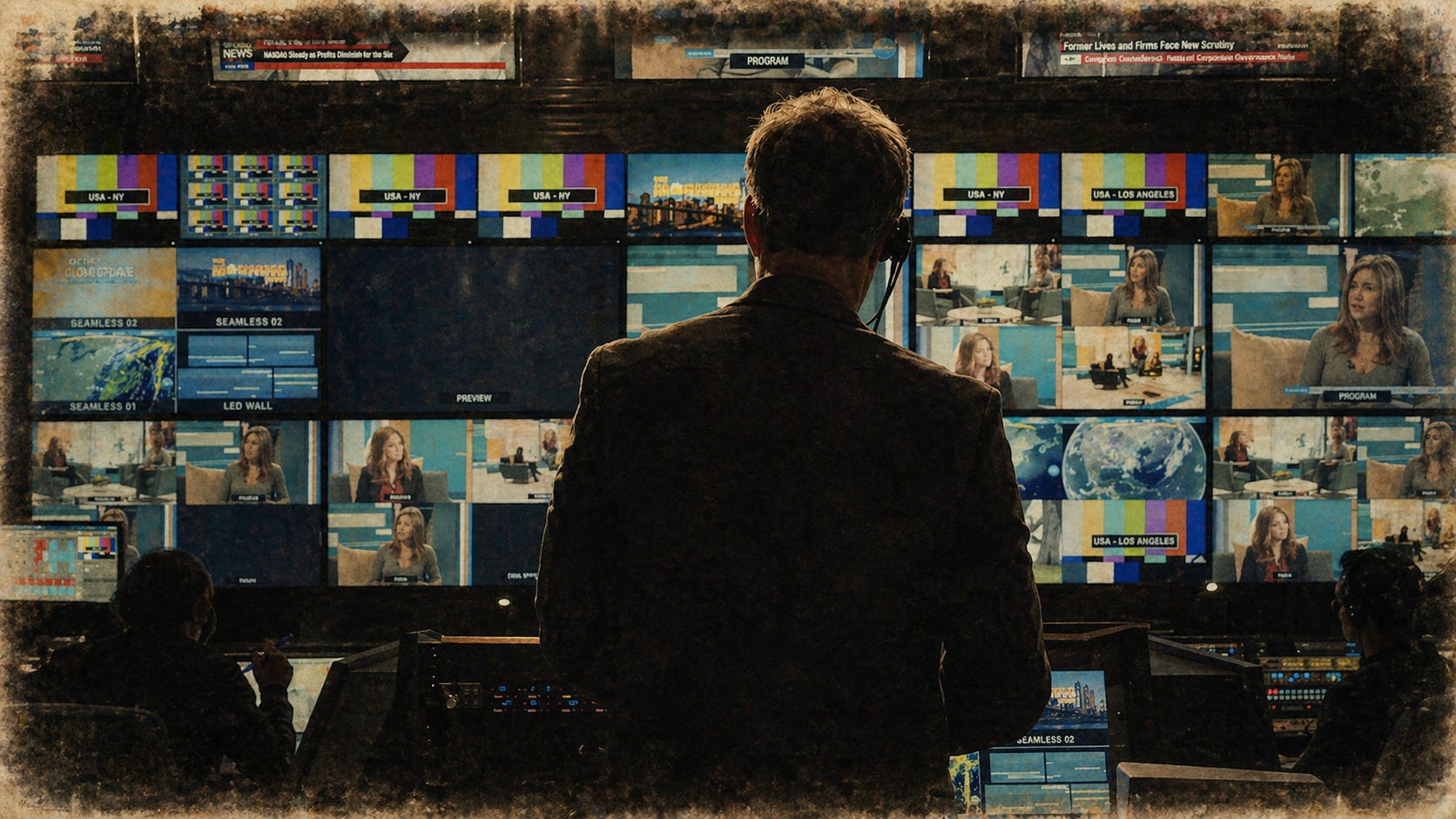
When media still had edges
There is a shift in media that most people sense but rarely name. We still talk about reaching audiences, building products, growing traffic, increasing engagement. As if we are still at the center. But if you watch how content actually moves now, the story changes. We are no longer the main interface between information and the user. We are just one layer in a stack, and not the one that matters most.
It was not always this abstract. Media used to have edges. Literal ones. A newspaper stopped at page 32. The news ended at 7:30, whether you were done or not. You bought the whole thing, not a slice. Consumption was limited by design, not just by bandwidth. If someone started reading, they usually finished. Editorial choices shaped the entire experience. Distribution was something you owned and could predict.
Infinite content, finite attention
Then the internet erased those edges. At first, it felt like freedom. No limits on length, frequency, or format. But the trade was clear: infinite content, finite attention. Suddenly, attention, not distribution, became the bottleneck. The rules shifted.
Media stopped competing with other media and started competing with anything that could steal a few seconds of attention. Analytics made this obvious. People did not read the way we hoped. They skimmed, dropped off, clicked away. Audiences did not vanish, but their behavior became fragmented and unpredictable. Control over consumption disappeared, along with the idea that good content would naturally hold attention.
Platforms moved the front door
Platforms did not just speed up the shift. They locked it in. Once users stopped visiting websites and started scrolling feeds, the center of gravity moved. Facebook, YouTube, TikTok did not kill media companies. They just changed their job description. Media stopped being the destination and became a supplier. Distribution was no longer built; it was bargained for.
At first, this looked like a win: massive reach, global audiences, almost no friction. Over time, it turned into dependency. Traffic could spike or vanish for reasons you could not see, because the system was not yours. You were optimizing for a platform that could change the rules overnight. And often did.
Trust shifts from brands to people
Meanwhile, trust was quietly moving. It shifted from institutions to individuals. Audiences responded to a recognizable voice, not a carefully managed brand. One person could build a direct relationship with millions. Something traditional media could rarely match.
Figures like Joe Rogan or Tucker Carlson are not just examples of scale. They show a different kind of connection. Less formal, less filtered, more direct. Media brands did not vanish, but they stopped being the default. They became just another option.
We already adapted. And then the ground shifted again
By the time this shift was clear, the industry had already adapted. It learned to work with algorithms, optimize packaging, and think in terms of channels instead of owned audiences. It accepted that control over distribution was now limited.
And just as that started to feel stable, the ground shifted again.
AI is not just another channel. It is a new kind of interface. It does not deliver your content; it processes, compresses, and rebuilds it. The user does not need to visit your site, scroll a feed, or even pick a source. They ask a question and get an answer. That answer might use your work, but it will not keep your structure, your tone, or your priorities. Tools like NotebookLM show this in a controlled way. Large-scale AI systems take it much further.
From distribution to interpretation
This is where the shift gets deeper. Platforms changed distribution. AI changes interpretation. In the platform era, you could assume that if your content reached the user, it would look the way you made it. In the AI era, that assumption is gone.
Your work becomes input for a system that produces something new. The user interacts with that, not with your original. The relationship is now so indirect it is almost invisible. The pattern is clear: control moves away from the creator, first over distribution, then attention, now meaning.
The paradox of modern media
And yet, one thing has not changed. High-quality journalism still does something none of these layers can replace. It captures reality. It gathers facts, checks them, and builds a coherent account of what happened. Even the best AI systems depend on that layer. They do not create new knowledge. They just reorganize what already exists.
This is the paradox. Media creates the most essential part of the value chain: the raw understanding of reality. But other layers capture more and more of the visibility and value. The better the system gets at repackaging and redistributing, the less visible the original source becomes. Even as it stays essential.
What we are actually building now
In practice, media is not disappearing. Its role is just being rewritten. It is no longer enough to design products for direct consumption. Content now has to survive multiple transformations. It has to move through platforms, adapt to new formats, and be legible to systems that will reinterpret it.
The challenge is not just to make content, but to keep its meaning and integrity as it passes through layers built for other goals. Content is no longer a finished product. It is a component in a system you do not control, for an audience you do not reach, through interfaces you did not choose.
No way back, only forward
It is tempting to think this is a cycle, that media will someday regain control over distribution or rebuild direct relationships at scale. But the direction of change does not support that hope. Each new layer adds abstraction and moves the user further from the source. The original content stays necessary, but it becomes less visible as its own thing.
Journalism will not vanish. The need to understand and explain reality is not going anywhere. But the idea that journalism naturally becomes stable, self-contained media products is already gone. What remains is the core function and the need to make it survive in a system built to reshape and reinterpret everything it touches.