

For years, managers across the technology industry lived with the same permanent anxiety: “We simply do not have enough resources.”
Not enough developers. Not enough designers. Not enough analysts. Not enough time. Not enough budget. Most product managers built their careers negotiating this triangle of constraint, usually with a new spreadsheet template every year.
Then AI arrived and quietly introduced a different question: What if resource constraints were never really the main issue?
Inside organizations, something odd is happening. Teams are producing more output than ever. Prototypes appear overnight. Marketing copy is generated in seconds. Research summaries arrive instantly. Roadmaps are assembled at a pace that would have seemed impossible a year ago. Everyone feels faster, more modern, more efficient, more ‘AI-enabled.’
And yet, many companies still somehow feel strategically stuck.
The uncomfortable part is that AI is making execution dramatically easier, but it is also exposing how weak prioritization was all along.
For decades, most organizations relied on a familiar tool: the four-quadrant prioritization matrix. Quick Wins in one corner: high value, low effort. Big Bets in another: expensive, potentially transformative. Fillers: small, low-impact tasks that keep people busy but rarely move the needle. And then the most dangerous quadrant: Time Wasters: initiatives that consume resources with little to show for it.
Traditionally, this model was mostly about tasks.
But AI changes something fundamental: the matrix is no longer only about tasks. It is now also about human behavior.
Because AI shifts the cost of execution so aggressively that entire categories of work begin moving between quadrants.
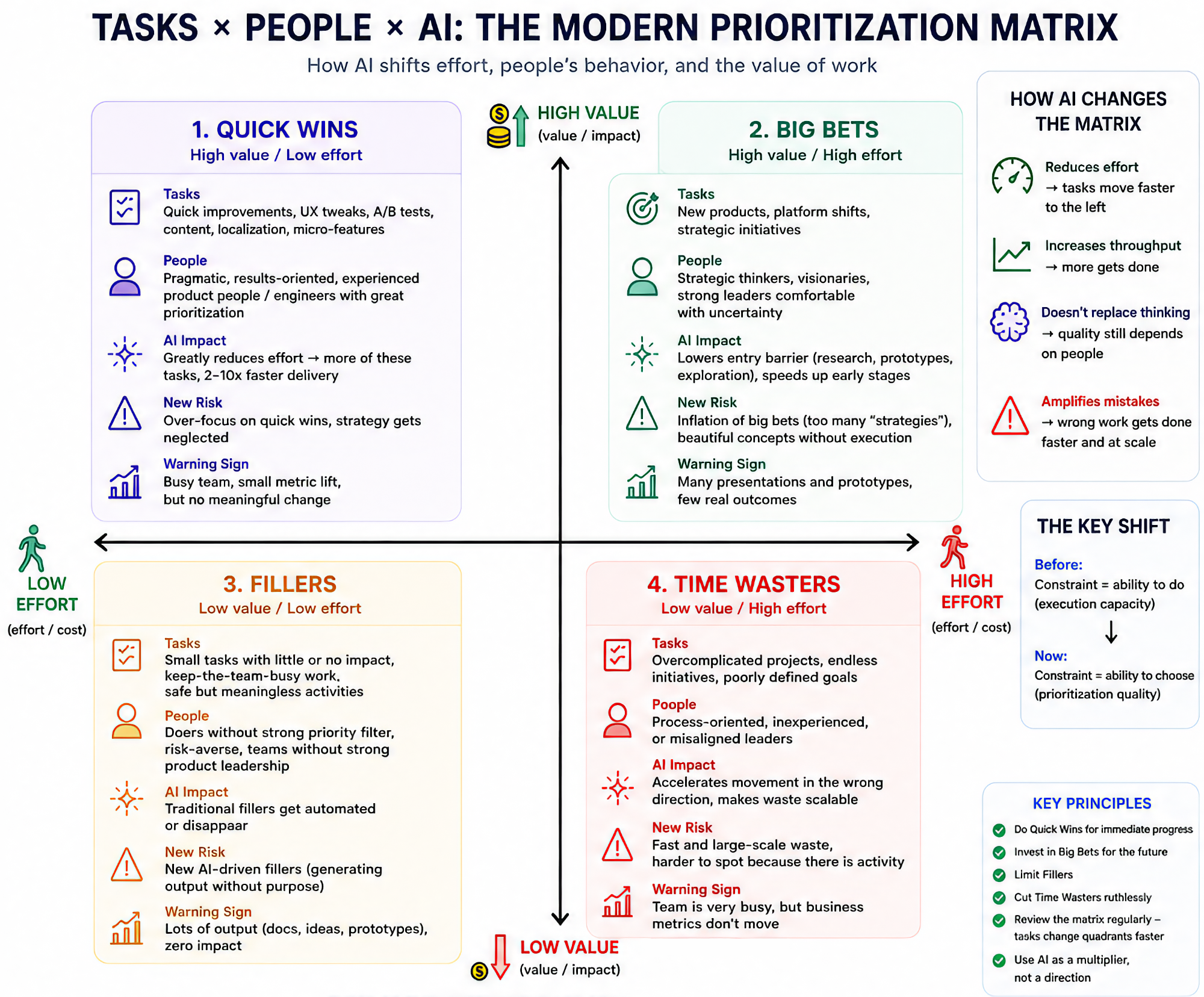
Quick Wins get even quicker. And more tempting. A UX tweak that once took weeks of coordination, design, copy, translation, and testing now happens almost instantly. Teams rack up small victories. Metrics nudge upward. Dashboards look healthier. Slack fills with launch announcements. Leadership sees movement and feels reassured.
But there is a subtle trap hidden inside this acceleration.
Organizations can become addicted to visible momentum instead of meaningful progress.
The company starts optimizing dozens of tiny things simply because they are now cheap to optimize. Everyone feels productive as the machine keeps generating visible output. Meanwhile, the harder strategic questions sit quietly in the background, like gym equipment people keep meaning to use.
Big Bets move in the opposite direction. AI lowers the barrier to entry for strategic thinking. Now, every team can generate polished concepts, vision decks, market analyses, technical architectures, customer personas, and future-state scenarios in hours. What once took weeks and real expertise now appears after a single workshop and a few prompts.
This creates a familiar illusion: organizations start confusing the ability to describe strategy with the ability to execute it.
And these are very different skills.
AI is good at helping people imagine futures. It is much less useful for navigating organizational politics, aligning stakeholders, rewriting processes, migrating legacy systems, changing company culture, or surviving budget reviews with finance teams who still expect innovation to be free.
So companies enter a period of strategic inflation. More Big Bets. More transformation initiatives. More AI-first roadmaps. More platform reinventions. More innovative language. More rockets on slides.
Not necessarily more outcomes.
Then there is the evolution of filler work. Historically, these were harmless activities: easy, safe, politically neutral. Small updates. Minor documentation changes. Cosmetic improvements. Tasks that created the feeling of progress without changing much.
AI has turned this category into something almost surreal.
Now organizations can generate filler work at industrial scale.
Summaries of meetings become summaries of summaries. Brainstorms produce AI-generated follow-up brainstorms. Documents generate more documents. Teams create entire ecosystems of polished output with no clear connection to business impact. Somewhere in the system, there is probably already an AI writing weekly reports that are read only by another AI generating executive summaries.
And somehow this does not even sound unrealistic anymore.
But the most dangerous transformation happens in the Time Wasters quadrant.
Historically, bad ideas at least faced natural friction. Terrible projects moved slowly because execution was expensive. Organizations had built-in protection: limited staff, limited time, limited coordination, human exhaustion, technical bottlenecks. Bad initiatives often collapsed under their own weight before they could do real damage.
AI quietly removes many of those friction points.
Now, companies can move in the wrong direction faster, longer, and with more confidence than before.
This is the truly uncomfortable part of the AI conversation that receives far less attention than prompts, copilots, and productivity gains.
AI does not improve judgment. It just amplifies it.
Good prioritization gets more powerful. Bad prioritization gets more expensive.
This leads to a familiar paradox: the teams that look most productive are not always the ones creating the most value. Some teams are becoming very efficient at producing motion without progress. Dashboards look fantastic. Velocity increases. Output explodes. Internal excitement grows.
Meanwhile, the company may be driving straight into a wall at full speed, with beautifully formatted AI-generated documentation explaining why the wall is a growth opportunity.
This is why the real bottleneck in the AI era is not execution capacity. It is the quality of prioritization.
The most valuable people are not the ones producing the most content, writing the most tickets, generating the most slides, or shipping the most visible activity. AI is handling more of that output every day.
The valuable people are the ones who can still calmly ask uncomfortable questions. Why are we doing this? What problem does it actually solve? Does this initiative deserve to exist at all?
And perhaps most importantly: Are we mistaking acceleration for direction?
Ironically, these are not futuristic skills. They are old-fashioned ones: judgment, taste, restraint, strategic clarity. The ability to say no before execution begins, not after resources disappear.
Unfortunately, these skills are much harder to showcase in a LinkedIn post than with screenshots of AI dashboards and words like “transformation”.
But beneath all the excitement, the reality is becoming surprisingly simple: AI boosts execution while humans still choose direction.
And choosing direction was always the hardest part.