

Every few weeks, a new wave of headlines arrives with a familiar message: AI is taking over journalism. Somewhere between conference slides, LinkedIn posts, and media think pieces, a number appears — 5%, 10%, sometimes much higher — suggesting that a growing share of news content is now written “by AI” or “with AI.”
It sounds dramatic. It is meant to sound dramatic.
The implied image is almost cinematic: invisible systems drafting articles at scale, quietly replacing human writers, reshaping the very idea of journalism. A reader scrolling through news feeds might reasonably assume that somewhere along the line, the byline has become… optional.
And yet, if you step inside an actual newsroom, the picture looks very different. Not less interesting — just less theatrical.
AI is indeed entering editorial processes at speed. But it is not marching through the front door, announcing itself as the new author of record. It is slipping in through side entrances — tools, assistants, small utilities — embedding itself into workflows in ways that are often invisible both to readers and, sometimes, even to the people describing them publicly.
Which raises a more precise question: when we say “AI is used in the newsroom,” what are we actually talking about?
What “using AI in the newsroom” actually means
The phrase AI-generated journalism suggests a binary reality: either a human wrote the article, or a machine did. In practice, the situation is far more nuanced and far more layered.
At one extreme, there are fully automated articles. These exist, but they tend to live in highly structured environments: sports results, financial earnings, weather updates, or election data. In these cases, the “article” is essentially a transformation of structured data into readable text. This is not new — variations of this have existed for years, long before the current generation of large language models.
At the other end of the spectrum is something much more common, but much harder to label.
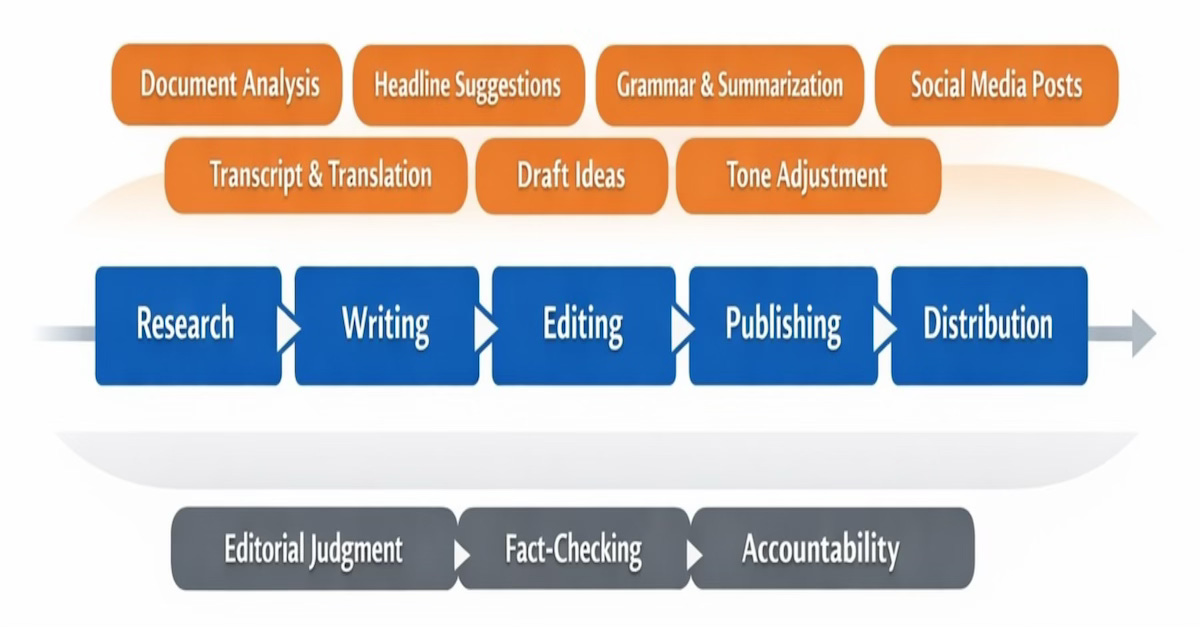
A journalist writes a story, but uses AI to generate five headline options and selects one. Another journalist feeds a long interview transcript into a tool to extract key quotes. An editor asks AI to shorten a paragraph, adjust tone, or produce a summary for social media. A producer uses it to translate material or suggest alternative framing for a lead.
None of these scenarios fit neatly into “AI wrote the article.” Yet all of them are part of the editorial process.
This creates a wide, almost elastic definition of AI usage. The same newsroom might claim both “we don’t use AI to write articles” and “AI is deeply integrated into our workflow” — and both statements would be true.
Which is why the discussion about percentages often feels misleading. It compresses a spectrum into a single number.
To understand what is actually changing, it is more useful to look not at how much content AI writes, but at where in the process AI is most effective.
The tasks AI automates first — and why
AI does not begin by taking over the most visible or prestigious parts of journalism. It begins with the work that journalists themselves would gladly spend less time doing.
Transcribing interviews that stretch over hours. Translating material from one language to another. Condensing long reports into usable summaries. Generating multiple headline options under time pressure. Cleaning up grammar, tightening structure, shortening text without losing meaning.
These tasks are not trivial, but they are procedural. They require effort, time, and attention — but not necessarily deep editorial judgment.
And that distinction matters.
AI performs best where the output can be quickly evaluated by a human. A headline can be judged in seconds. A summary can be compared to the source. A transcript can be verified against audio. The human remains firmly in control, but the machine accelerates the process.
By contrast, tasks that require interpretation, contextual understanding, and accountability — deciding what the story is, which facts matter, how they should be framed — remain much more resistant to automation.
AI enters the newsroom not by replacing judgment, but by reducing friction. It removes the small delays that accumulate across the workflow — the minutes that become hours, the hours that become days.
And once those delays begin to disappear, something else happens. AI starts to spread into places where its presence is less obvious.
Where AI is used quietly
The most interesting part of AI adoption in journalism is not where it is visible. It is where it is not.
Public discussions tend to focus on the idea of AI writing articles. Inside newsrooms, much of the real impact happens earlier (and later) in the process.
Before a single line is written, AI may already be involved. It can help navigate large document sets, extract key points from reports, identify patterns across sources, or surface relevant material from archives. For investigative work, this is particularly valuable: not as a source of truth, but as a way to reduce the time needed to find where truth might be hiding.
None of this appears in the final publication. The reader never sees the hours saved. After the article is written, another layer of quiet activity begins.
A single piece of journalism rarely lives as a single piece anymore. It needs to be adapted — for search, for mobile, for social media, for newsletters, for different audience segments. Each of these requires slightly different wording, structure, or emphasis.
This is where AI is extremely efficient.
It can generate variations quickly, test different angles, produce summaries of different lengths, and adapt tone depending on the channel. Again, the journalist remains responsible for the content — but the distribution layer becomes increasingly assisted.
In effect, AI is not just participating in journalism. It is participating in how journalism moves.
What the real AI workflow in major newsrooms looks like
If you strip away the narratives and look at how large news organizations actually operate today, the workflow is less revolutionary than evolutionary.
The core remains intact. A journalist investigates, interviews, verifies, and writes. An editor reviews, challenges, refines. Accountability sits with people, not systems.
Around this core, however, a new layer has formed.
During research, AI may assist in processing documents or transcripts. During writing, it may offer structural suggestions or alternative phrasings. After writing, it contributes to headlines, summaries, and distribution formats. Throughout the process, it acts as a tool — sometimes helpful, sometimes ignored, occasionally wrong.
Importantly, it is rarely autonomous.
The idea that AI writes an article and a human simply approves it is not how most serious newsrooms operate. The direction is usually the opposite: a human creates the material, and AI supports specific steps around it.
This distinction may seem subtle, but it is fundamental. It defines whether AI is an author or an instrument.
For now, in most traditional news organizations, it is very clearly the latter.
A few conclusions
So how deeply is AI embedded in journalism?
Deep enough to matter. Not deep enough to replace it.
The more accurate picture is not one of sudden disruption, but of gradual integration. AI is becoming part of the infrastructure of news production: accelerating research, simplifying editing, enabling faster and more flexible distribution.
At the same time, the boundaries are holding. The closer we get to the core of journalism — facts, interpretation, accountability — the more cautious newsrooms remain.
This creates an interesting tension.
From the outside, it looks like AI is writing the news. From the inside, it feels more like AI is reorganizing the work around the news.
And perhaps that is the more useful way to think about it.
Journalism is not being replaced. It is being restructured — one quiet workflow improvement at a time.